Information is taken from the game and may change or differ over time. Last updated .
Unlocked at Accreditation Tier 1
Statistics
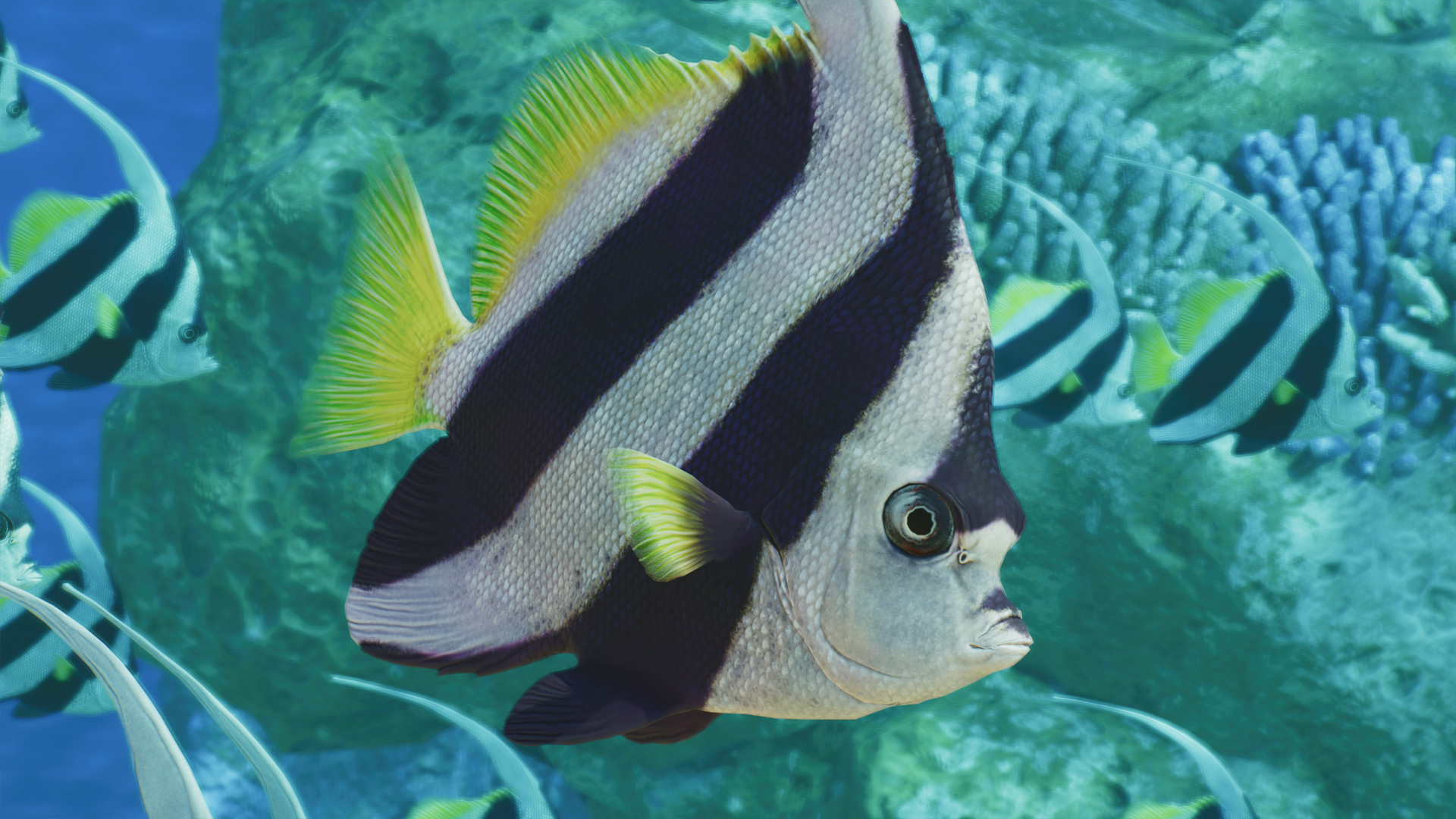
The schooling bannerfish (or Heniochus diphreutes) is a marine fish found across the Indo-Pacific region, ranging from the eastern coast of Africa and the Red Sea to the central Pacific, including Indonesia, Australia, and Hawaii. It inhabits outer reef slopes and lagoons where it forms large, active schools in open water.
The species has a white body with two bold black vertical bands, yellow tail and dorsal fin, and a long, trailing extension on the dorsal fin.
Adults grow to an average length of 15cm to 20cm.
- The schooling bannerfish feeds almost exclusively on zooplankton, using quick, precise movements to capture tiny drifting animals from the water column.
- The schooling bannerfish has a long, trailing extension on its dorsal fin that looks like a banner or flag, which not only gives it its name but also helps it blend in among soft corals.
- The schooling bannerfish shows little to no sexual dimorphism, meaning males and females look nearly identical and can be difficult to tell apart outside of breeding events.
- The schooling bannerfish relies on schooling behaviour for survival, using group movement to confuse predators and increase foraging success in plankton-rich currents.
- The schooling bannerfish closely resembles the longfin bannerfish, but unlike its lookalike, it is a true schooling species, often seen swimming in large, coordinated groups.
Habitat
Minimum habitat requirements
Planned population
Space
Environment
Preferred group ranges
Social
The schooling bannerfish is a shoaling fish and is often found in large groups up to several hundred.
Thriving relationships
0iNo compatible species
Release
Release requirements
Mixed Shoal
Shoal health 30%. Release Groups can only be released via Conservation Projects or Quick Release.
Conservation
The schooling bannerfish is a species of Least Concern, with conservation challenges for habitat degradation and the aquarium trade. Coral reef ecosystems are under increasing threat from climate change, particularly coral bleaching events, rising sea temperatures, ocean acidification, and pollution. As a species that depends on healthy reef structures for food, shelter, and reproduction, the degradation of coral environments dramatically affects their survival. Schooling bannerfish are popular ornamental fish due to their striking appearance and peaceful behaviour.
Efforts to mitigate these threats are largely focused on marine protected areas (MPAs), sustainable harvesting practices, and coral reef conservation initiatives. MPAs offer critical safe zones where bannerfish populations can breed and thrive. Regulations on the aquarium trade, including collection quotas and certification schemes aim to ensure individuals are sourced responsibly.
Although not currently a conservation priority species, it benefits indirectly from broader reef protection efforts, and continued research is essential as environmental pressures increase.
Research
| Level | Unlocks | Bonus | Research gate |
|---|---|---|---|
| 1 | Fertility Level 1 | Fertility (+15%) | |
| 2 | Schooling Bannerfish Fact Sheet | ||
| 3 | Fertility Level 2 | Fertility (+30%) |
Conservation topics
Life
Reproduction
Lifecycle
Breeding
Breeding usually occurs in the evening hours, synchronised with lunar or tidal cycles, though the exact mating season may vary across their range. The schooling bannerfish is monogamous, with males and females forming pairs during spawning, often within or near their schools.
Females release 3000 to 4000 small, buoyant eggs, which are fertilised externally by the males. The eggs hatch within 24 to 48 hours, depending on water temperature, and the larvae drift in the open ocean as plankton for several weeks before settling onto the reef.
Juveniles resemble miniature adults and grow rapidly, reaching sexual maturity at around 10 to 12 months of age. The species is thought to reach full adult size by 1.5 to 2 years.