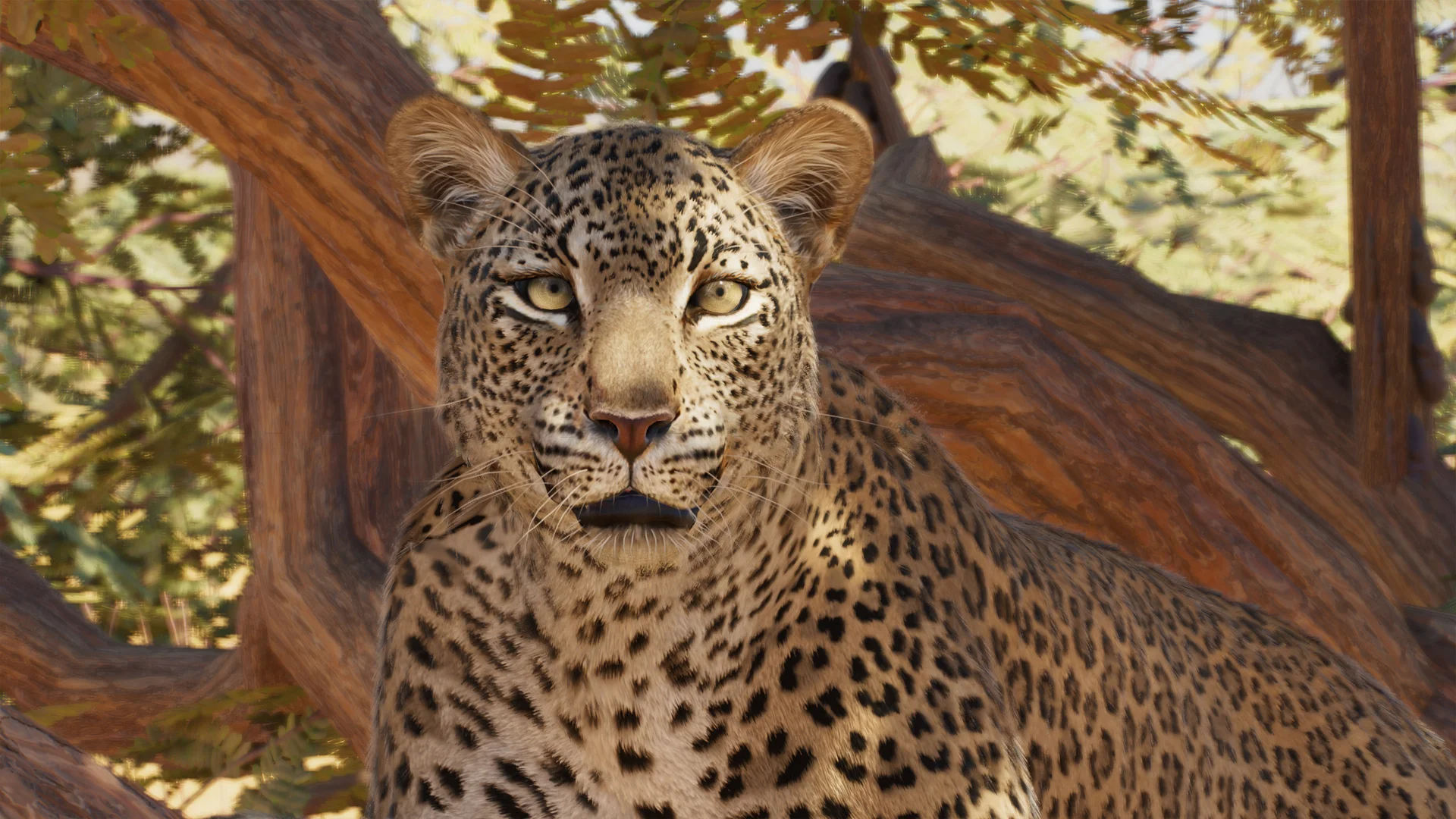
Panthera pardus pardus
About
General
The African leopard is the nominate subspecies of the leopard, native to Central and Southern Africa. It has a slender build with an elegant head. The base coat colour ranges from yellow to dark golden and is covered in small, tightly spaced rosettes that turn into black spots towards the lower body, face, and tail tip. The underside and inside of the legs are white. The African leopard is sexually dimorphic, with males being larger and heavier than females. Males are 60cm to 70cm tall at the shoulder, 1.52m to 1.83m long, with an extra 66cm added by the tail, and weigh 58kg to 96kg. Females stand 55cm to 65cm tall at the shoulder, are 1.39m to 1.67m long with a 60cm tail, and weigh 24kg to 37.5kg.
Conservation Status
Despite the African leopard's wide range and reputation for adaptability, it is considered a Vulnerable species. Agricultural and urban expansion as well as logging fragment their habitat, reducing access to prey populations. Poaching and illegal wildlife trade also pose serious threats, as leopard skins, claws, and teeth are sought after for traditional rituals or as hunting trophies for one of Africa's 'big five'. Conservation efforts focus on legal protection, habitat conservation, and community engagement: Many countries restrict hunting and trade, and protection under Appendix I of CITES prohibits international commercial trade of wild-caught specimens. Protected areas and wildlife corridors support leopard populations while reducing human-wildlife conflict. Community programs educate local people about the ecological role of leopards, and provide incentives for coexistence, such as compensation for livestock losses or the promotion of eco-tourism. Long-term success depends on continued funding, research, and collaboration between governments, NGOs, and local communities.
Social & Reproduction
African leopards are solitary except for a mother raising her cubs. African leopards can mate year-round. Oestrus cycles last about 46 days and the female is receptive for a week per cycle. Males track females via their vocalisations and urine markings. A pair will remain together for a few days and mate several times throughout this period before separating again. The gestation period lasts 3 to 3.5 months, after which a litter of 2 to 4 cubs is born in a den or crevice, though in the wild only 40 to 50% of cubs survive their first year. They are born blind and helpless and remain in the den for the first weeks of their life. At 9 weeks old, they begin eating solid food, and start following their mother on hunting trips at 3 months old. Cubs stay with their mother for up to 2 years, though are able to survive on their own from 1 year old onwards. Upon separating from their mother, young leopards may travel with their siblings for a little while longer, before eventually dispersing into a fully solitary lifestyle. Leopards reach sexual maturity at about 2.5 years old.
Habitat
Social
Biology
 2.49 m
 2.27 m 96 kg 37.5 kg