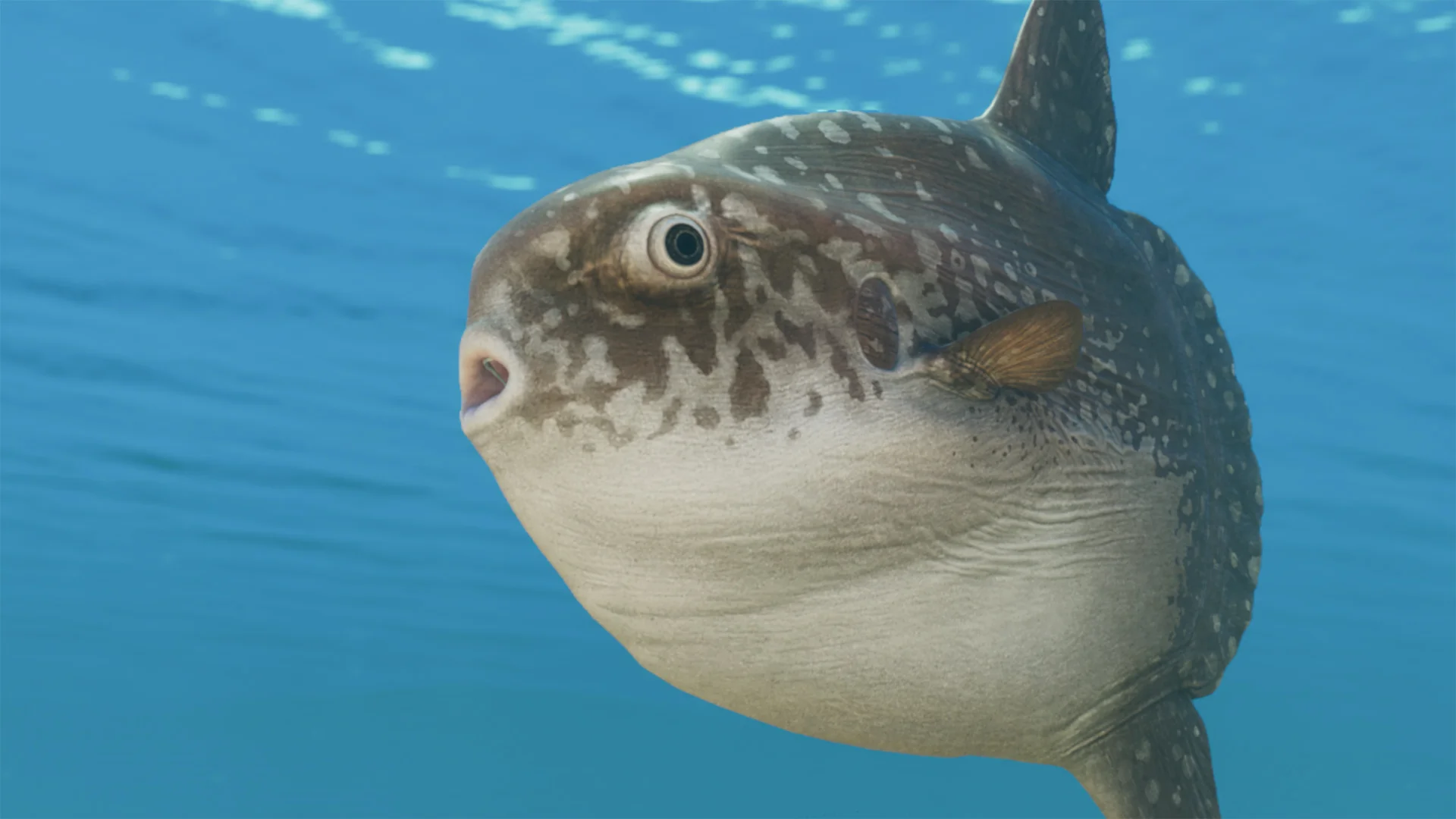
Mola mola
About
General
The ocean sunfish is a large unusual-looking fish found in temperate and tropical oceans around the world. It typically lives in the open ocean and is usually seen near the surface of the water. It has a flattened, disc-like body with tall dorsal and anal fins and no true tail. Despite their size, they are gentle, slow-moving creatures that glide through the water feeding mainly on jellyfish and other soft-bodied prey. Adults measure an average of 1.8m to 2.5m weigh an average of 247kg to 1000kg.
Conservation Status
Ocean sunfish are classed as vulnerable. They face many challenges including fishing bycatch, mistaking ocean plastic for jellyfish and ingesting it, and boat strikes due to their slow swim speed and habit of spending time floating at the surface. Climate change affects their habitat and the availability of their food, and their large body size accumulates ocean pollutants in their tissues. They are vulnerable to many species of parasites and take a long time to reach sexual maturity. A lack of information on sunfish biology causes barriers to conservation. Scientists are tagging and tracking sunfish to highlight problem areas where sunfish are caught as bycatch for strategic fishing restrictions. Sunfish bycatch must be reported in certain areas such as within the EU. Introduction of Marine Protected Areas (MPAs) where sunfish are prevalent also helps conserve sunfish. Finally, ocean clean ups and education on sunfish and ocean pollution help raise awareness, and improve public action and conservation legislation.
Social & Reproduction
Ocean sunfish are solitary animals. The breeding season of ocean sunfish is poorly understood due to the deep, pelagic habitat of the species, but estimated year-round with peaks between August and October. Ocean sunfish reproduce through external fertilisation; females release eggs and males release sperm into the water column simultaneously. Females release hundreds of millions of eggs several times through the breeding season. Most of these eggs will not hatch and most hatchlings will not survive to adulthood. The eggs are microscopic, but once fertilised, they hatch into tiny larvae that look very different from adult sunfish. They have a more traditional fish-like shape with spines and fins adapted for survival at this vulnerable stage. Larvae are planktonic, drifting with ocean currents and feeding on small organisms until they grow large enough to begin developing the distinctive sunfish body shape. As the larvae grow into juveniles, the tail fin disappears, and the body becomes more rounded and laterally compressed. Juvenile sunfish grow rapidly and reach sexual maturity at 5 to 7 years old. They continue to grow throughout their lives.
Habitat
Social
Biology
 2.5 m
2.5 m 2.5 m 1000 kg 1000 kg