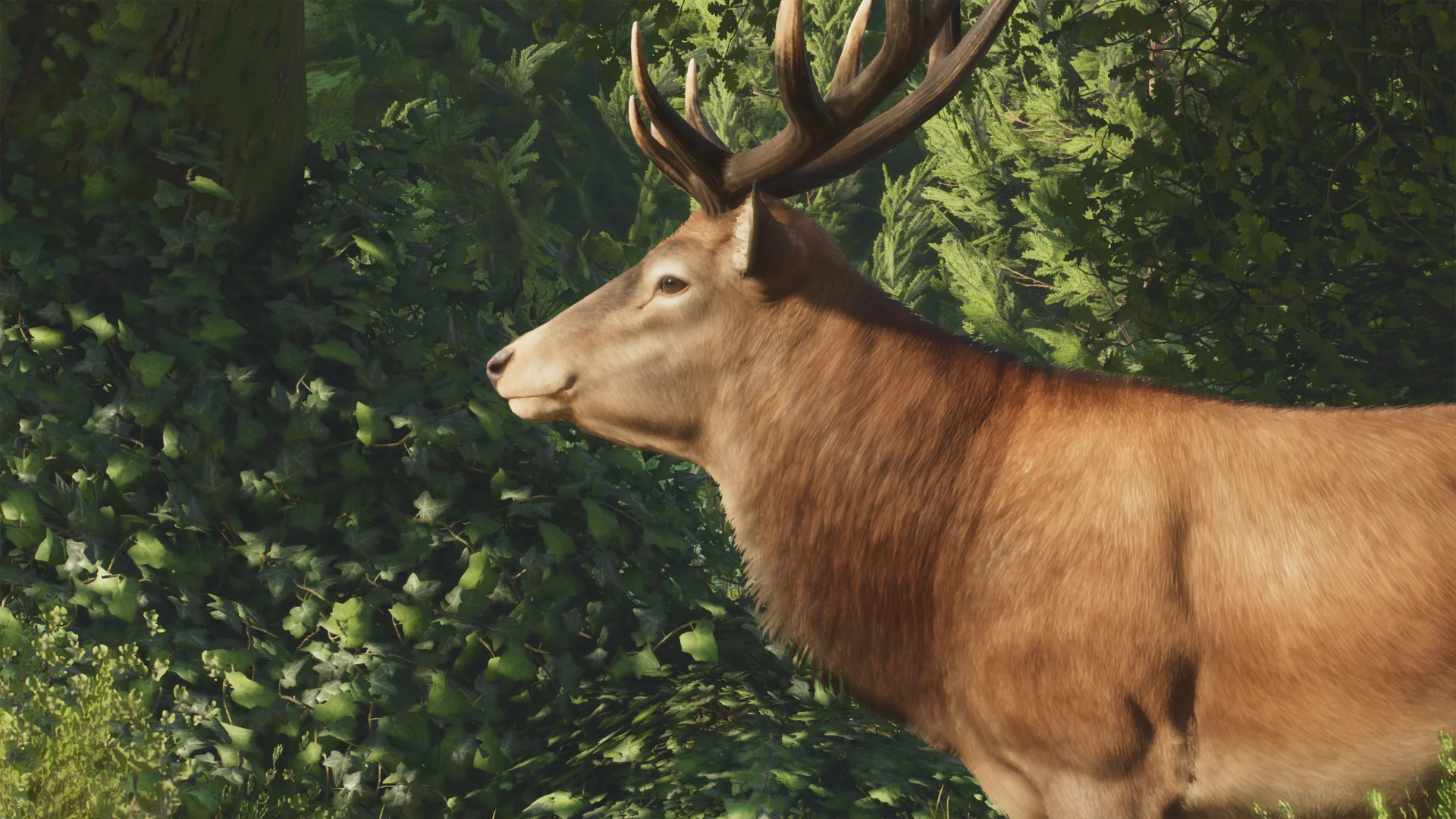
Cervus elaphus
About
General
The red deer (Cervus elaphus) is a widespread ungulate found throughout the temperate grasslands, woodlands, and scrublands of Europe, Northern Africa, and Central Asia, and has been introduced to South America and Oceania. It has a red-brown coat with a pale underside, large pointed ears, and a long snout. The species is sexually dimorphic: males are larger and carry distinctive U-shaped antlers with multiple prongs measuring 60–80cm. Males average 175–250cm in length and weigh 160–240kg; females measure 160–210cm and weigh 120–170kg.
Conservation Status
The red deer is Least Concern but has become locally extinct across parts of its historical range due to overhunting, deforestation, and agricultural expansion. Since the 20th century, conservation programmes including legal protection, habitat restoration, hunting regulations, and protected areas have restored populations across much of their former range. Reintroduction projects have been key where natural recolonisation was unlikely due to habitat fragmentation. Red deer are now regarded as a European wildlife conservation success story, with rewilding initiatives further reinforcing their role as ecosystem engineers through vegetation shaping, seed dispersal, and nutrient cycling.
Social & Reproduction
Red deer form loose herds of up to 400 animals depending on season and food availability. Related females and their offspring form bonded groups; young males live in bachelor groups of 4–10, learning dominance displays and fighting; older males tend to be solitary outside breeding season. Mating occurs in late summer, when males vocalise loudly, display, and clash antlers to defend a harem of around 6 females. After a pregnancy of 240–262 days, the female leaves the group to give birth to a single fawn, returning to the herd after 16 days. Fawns begin eating grass at 16 days and are fully weaned by 2 months. Females reach sexual maturity at 16 months and typically first mate at 2 years; males are unlikely to compete successfully until 4–5 years when their antlers are fully developed.
Habitat
Social
Biology
 2.13 m
 1.85 m 200 kg 145 kg