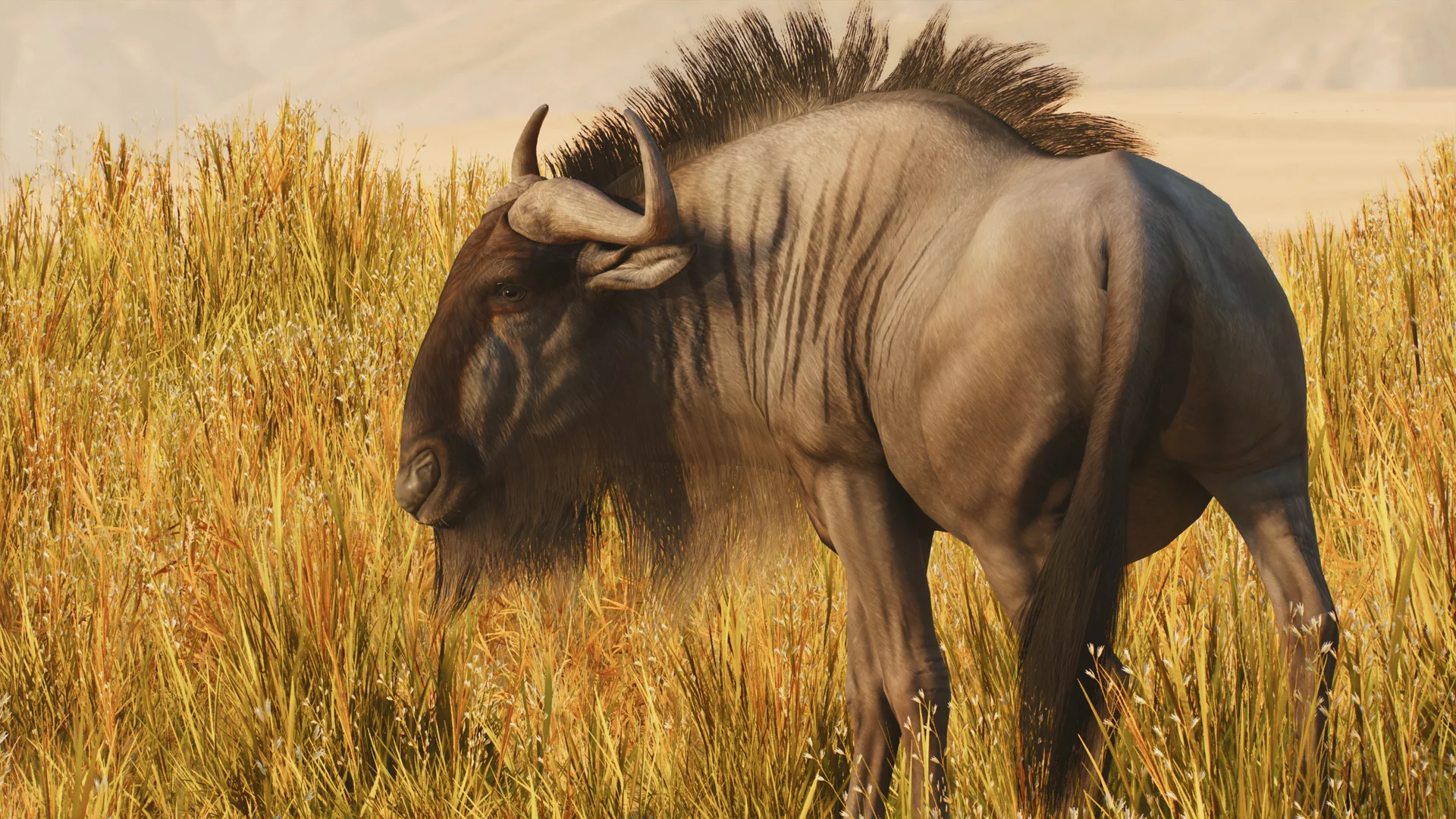
Connochaetes taurinus
About
General
The blue wildebeest (or Connochaetes taurinus) is a large antelope native to Southern Africa, also known as the common or white-bearded wildebeest, or brindled gnu. They have a pale grey or brown coat with dark stripes across their neck, shoulders, and chest, a long black tail and mane, and a white beard. Both sexes have distinctive L-shaped horns. Males stand 1.23–1.65m tall and weigh 165–290kg; females are slightly smaller at 1.14–1.42m and 140–260kg.
Conservation Status
Blue wildebeest are considered Least Concern. Threats include habitat fragmentation from agriculture and urban development disrupting migratory routes, climate change limiting grazing and water resources, disease transmission from livestock (notably rinderpest), poaching, and competition with livestock. Conservation successes include the eradication of rinderpest through coordinated veterinary campaigns, protection of migration corridors, community coexistence programmes, and reintroduction efforts that have stabilised or increased numbers in several regions.
Social & Reproduction
Blue wildebeest live in large herds comprised of female subgroups with offspring, bachelor herds, and territorial bulls. During the three-week breeding season at the end of the wet season, dominant bulls track fertile females and may engage in lekking — gathering in all-male groups to display, spar, and vocalise. Victorious males secure mating rights and may gather a small harem. After a pregnancy of around 8.5 months, a single calf is born, weaned by 8–10 months. Females reach sexual maturity at 16 months, males at 2 years, though it may take longer before they can hold a territory or win a lek.
Habitat
Social
Biology
 1.65 m
 1.42 m 290 kg 260 kg