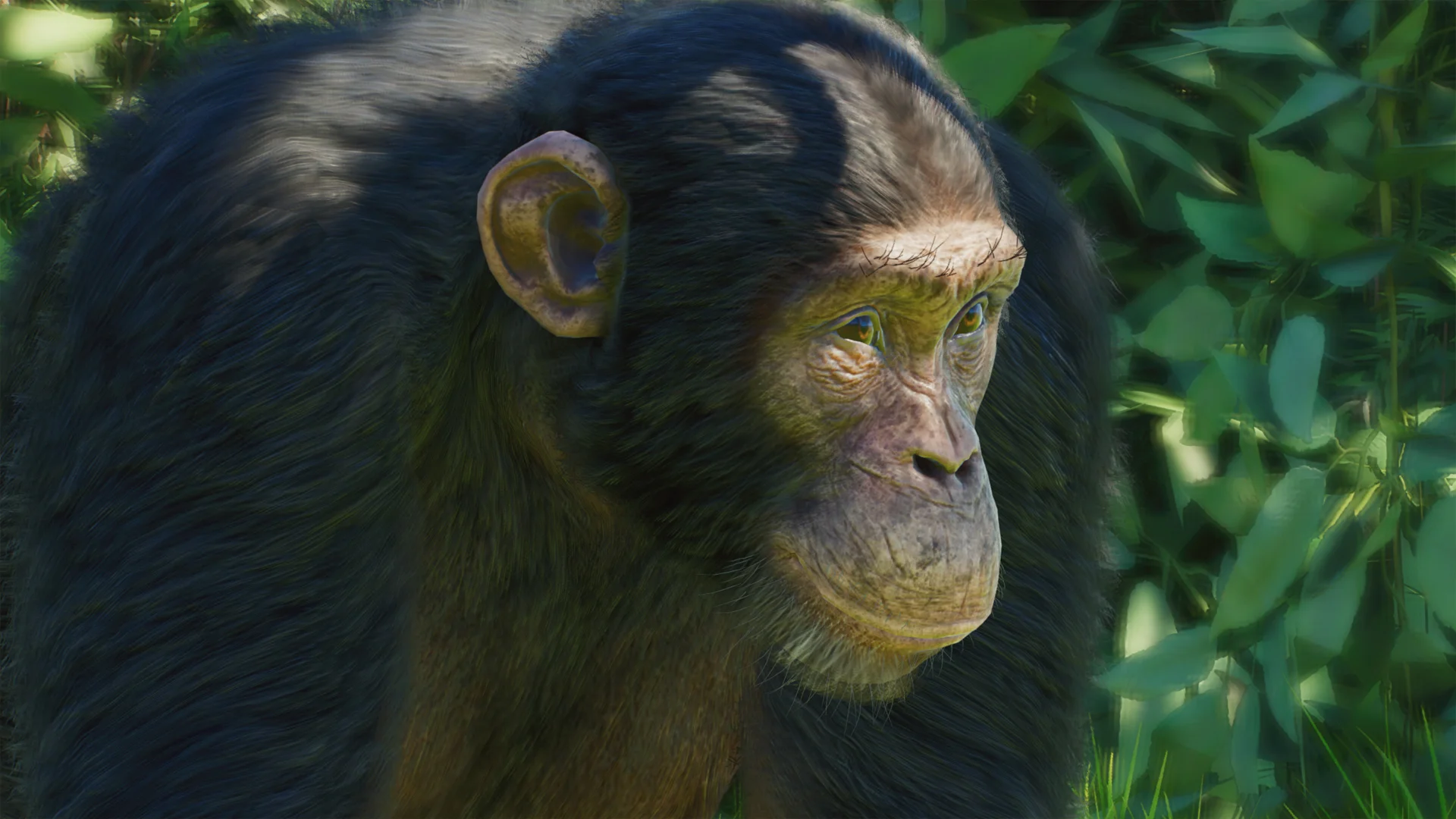
Pan troglodytes verus
About
General
The Western chimpanzee (or Pan troglodytes verus) is a subspecies of the common chimpanzee native to the forests of Guinea, Liberia, Senegal, Sierra Leone and the Ivory Coast. Along with bonobos, they are the closest living relatives of human beings, sharing more than 98% of our DNA.
They have black hair, brown skin and eyes, long arms, hands and feet, with opposable thumbs that allow for more complex motor functions. While the subspecies is not that visually distinct from the Central and Eastern chimpanzees, the population of Western chimpanzees has been isolated for half a million years and is now genetically distinct.
Chimpanzees are 1m to 1.5m tall when standing. Males are larger and also heavier than females, at 40kg to 70kg compared to 27kg to 50kg.
Conservation Status
Western chimpanzees are Critically Endangered, threatened by habitat loss due to deforestation and agricultural expansion, as well as poaching for bushmeat, traditional medicine and the illegal pet trade. While they are protected under national and international laws, the enforcement thereof is weak. About 30% of chimpanzees live in protected national parks, but the rest of the population remains very vulnerable. Additionally, civil conflicts in West Africa result in a lack of united, cross-country conservation legislation in the region.
An action plan for successful conservation of the Western chimpanzee involves further research into their habitat, life history and risk factors. This may improve ethical land use in further expansion into their habitat, as well as legal protection through better enforcement of poaching laws. Fundraising and public awareness campaigns help support the ongoing conservation and research work and educate the public about the danger our closest relatives are in.
Social & Reproduction
Chimpanzees are very social animals, living in large groups in the wild. Males are dominant in chimpanzee society, with their age being a primary determining factor in their hierarchy. The males in individual groups are interrelated, while unrelated females migrate in from other groups, and they will all further their social bonding by hunting together and grooming each other. They will even learn skills from one another, such as how to use sticks and rocks as tools.
Chimpanzees are promiscuous animals, with both males and females mating with multiple partners throughout their lifetime. The alpha male gets first pick of a female partner, while some males may keep their chosen females away from other males because of their promiscuity. Mating occurs year-round.
The pregnancy of a female chimp lasts 8 months before giving birth to a single infant, which the mother will take care of until it reaches around 4 years old. At this point, the offspring will begin to distance from its mother. It is at this age that young males will begin to form close bonds with other males within the group, while females will begin to explore away from the family group.
Females will leave their group at around 10 years old in search of an unrelated group, while the males remain with their original family. Chimpanzees reach sexual maturity as early as 8 years old, but often only successfully reproduce at 13 to 16 years old.
Habitat
Social
Biology
 1.5 m
1.5 m 1.5 m 70 kg 50 kg