Aglais io
About
General
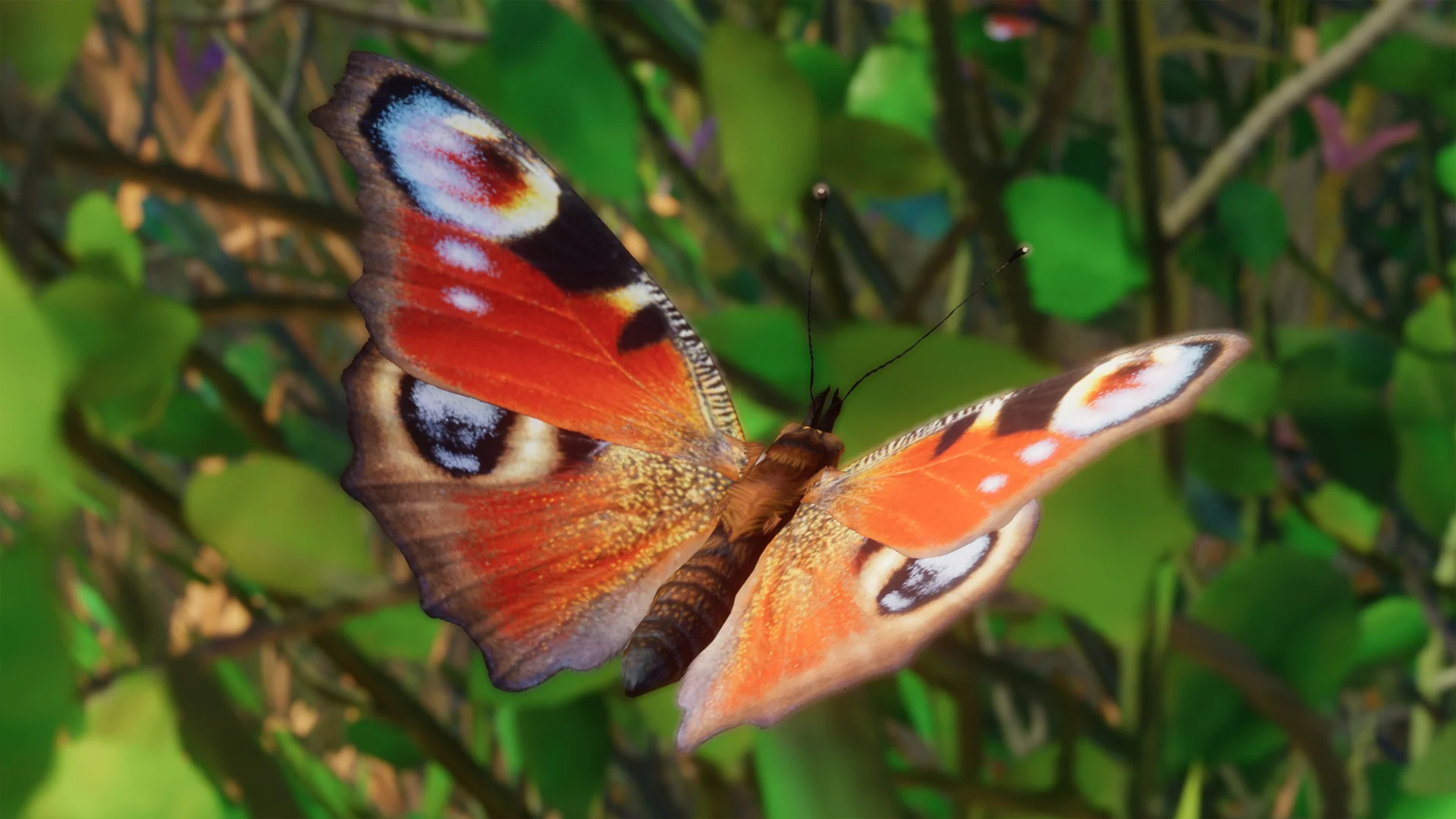
The European peacock (or Aglais io) is a species of butterfly living throughout the temperate grasslands and woodlands of Europe and Asia.
It has four red wings with brown edges and distinctive eye spots. These eye spots may be made up of yellow, blue, red or purple scales and have black surrounding marks. The undersides of the wings are brown to black. Caterpillars of the European peacock are black and hairy, and the chrysalises are green with pointed ridges on the dorsal side.
Males and females look alike, although females may be up to 10% larger than males. European peacocks reach a wingspan of 5cm to 6.4cm.
Conservation Status
European peacock butterflies are considered a species of Least Concern. It is not believed to face significant threats. Its population, growth speed and behaviour are all subject to weather conditions, with up to 3 generations a year and varying visible populations across normal years. All butterflies are collected to some extent, but there is no trade information of concern for this species.
This species occurs in a number of protected areas across its native range but has no specific conservation actions.
The European peacock is an abundant and widespread species across its range. Populations should continue to be monitored by research schemes, which show a small expansion in recent years.
Social & Reproduction
The European peacock butterfly is largely solitary and males may defend their territory from other males they encounter.
Mating season is between May and August, occurring after winter hibernation for those emerging later in the year. Males aggressively defend territory around sun-exposed flowers against rival males through airborne fights and pursue females feeding from the flowers. Females take off in flight when approached and only mate with a male that can keep up during the pursuit. If a female accepts a male, the pair lands on a leaf to mate by facing away from each other and joining their abdomens.
After mating, females lay eggs in batches of approximately 400 at a time, on the underside of a sunny nettle leaf up to 3 separate times. Caterpillars hatch from the eggs 1 to 2 weeks after laying and create a communal silk web around their birth leaf. They all feed from this leaf until it is skeletal, after which they disperse and feed independently.
The caterpillars of the European peacock go through five instars – developmental phases – over a period of approximately 3 weeks before finding a hidden place to pupate. Pupation lasts 2 to 4 weeks depending on environmental conditions, after which they emerge as adult butterflies in July. Females lay eggs towards the end of their lifespan in May and roughly a year after their emergence. Due to the shorter lifespan of males, this results in most males and females only mating with one partner.
Habitat
Social
Biology
 6 cm
6 cm 6 cm
6 cm