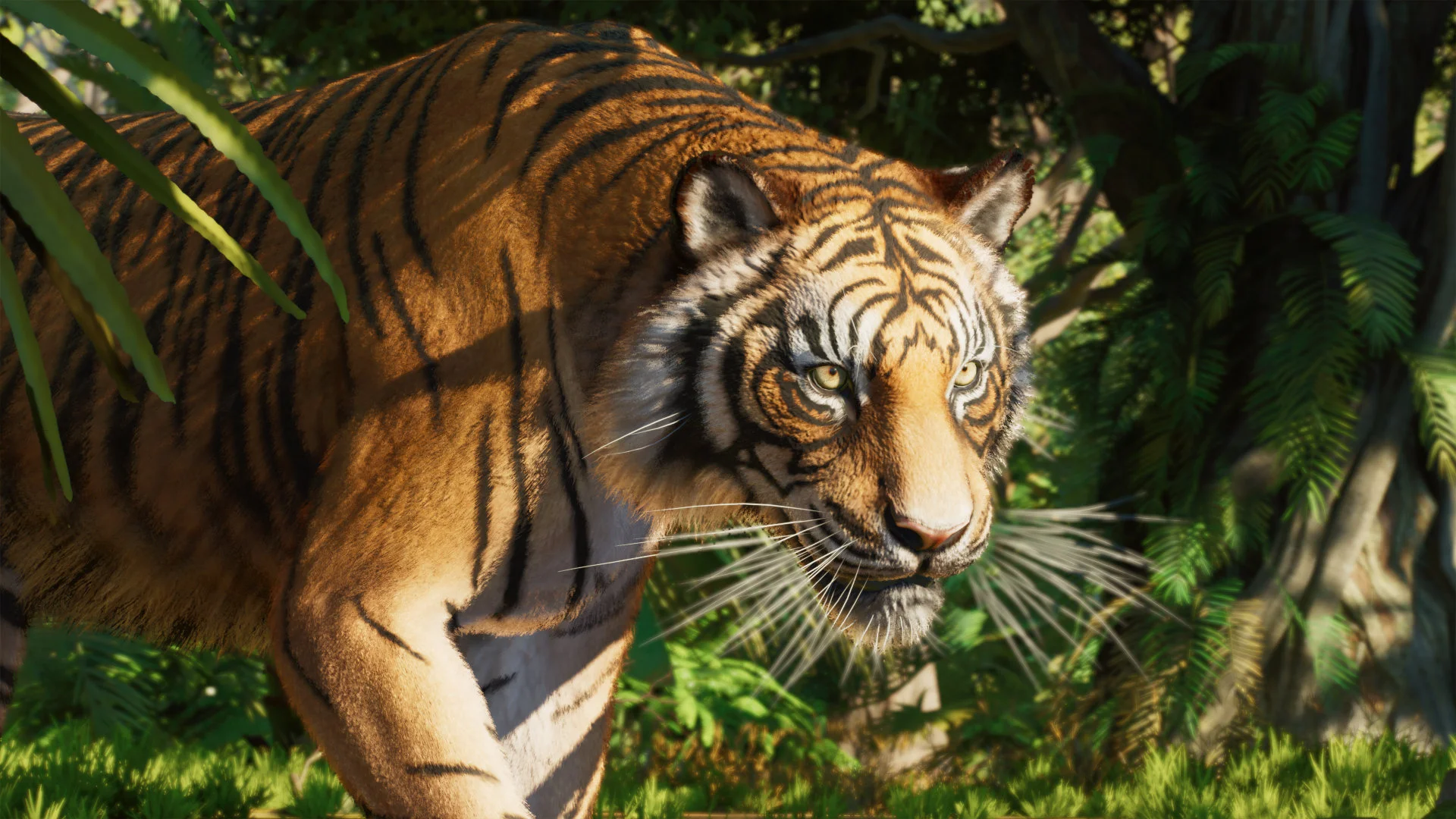
Panthera tigris sumatrae
About
General
Wild Population: 400 - 600 (estimated)
The Sumatran tiger (or Panthera tigris sumatrae, sometimes also Panthera tigris sondaica) is a subspecies of tiger native exclusively to the Indonesian island of Sumatra. It inhabits dense tropical forests, including lowland and montane rainforests, and peat swamps.
Sumatran tigers have orange coats marked with narrow black stripes, and they often have a more pronounced mane of fur around the face compared to other tiger subspecies.
Sumatran tigers are the smallest tiger subspecies. Males typically measure 2.2m to 2.5m in length, including the tail of about 0.85m to 1m length, and females are slightly smaller at 2m to 2.3m total length. Adult males weigh 100kg to 140kg, females weigh around 75kg to 110kg.
Conservation Status
All tiger subspecies are currently Endangered, although under the tiger's previous taxonomic assessment, Sumatran tigers were assessed as Critically Endangered. Vast areas of Sumatra’s rainforests are cleared for palm oil plantations, logging, and agriculture. The resulting fragmentation of the tiger’s habitat makes finding food and mates difficult, and often forces them into conflict with humans, leading to retaliatory killings. Poaching is another threat, as their skins and body parts are highly sought after on the black market.
NGOs and the Indonesian government are working to reverse the tiger’s decline through habitat protection, anti-poaching enforcement, and community education. National parks serve as vital refuges for the species, and patrol units remove snares and deter illegal hunting. Local initiatives reduce human-tiger conflicts by promoting coexistence strategies. Ex-situ, breeding projects ensure a genetically healthy insurance population in accredited zoos for potential future reintroductions.
Together, these coordinated efforts aim to secure a sustainable future for one of the world’s most endangered big cats.
Social & Reproduction
Sumatran tigers are solitary animals. They only interact with each other to mate, with the exception of a mother with her cubs.
The courtship and mating behaviour of the Sumatran tiger takes place year-round, with peaks in the rainy season. Sumatran tigers are highly territorial and solitary. Males and females come together only for mating. A receptive female marks her territory with scent and vocalisations, attracting nearby males. If multiple males track her and meet, they will fight over the right to mate. When the male and female meet, they engage in a short period of courtship involving scent rubbing, chuffing (a friendly vocalisation), and gentle nipping. Mating occurs several times over a few days to ensure fertilisation, after which the male departs, leaving the female to raise the cubs alone.
After a gestation period of 100 to 110 days, the female gives birth to a litter of 2 or 3 cubs, occasionally up to 5. Cubs rely entirely on their mother’s protection and milk for the first few weeks. She keeps them hidden in a dense thicket or cave, moving them frequently to avoid predators. By about 2 months old, the cubs begin to eat meat, and by 6 months, they start learning hunting skills by watching their mother.
Young tigers remain with their mother for around 1.5 to 2 years, after which they become independent and establish their own territories. Sexual maturity is reached at about 2 years old.
Habitat
Social
Biology
 2.5 m
2.5 m 2.3 m 140 kg 110 kg