Sphyrna mokarran
About
General
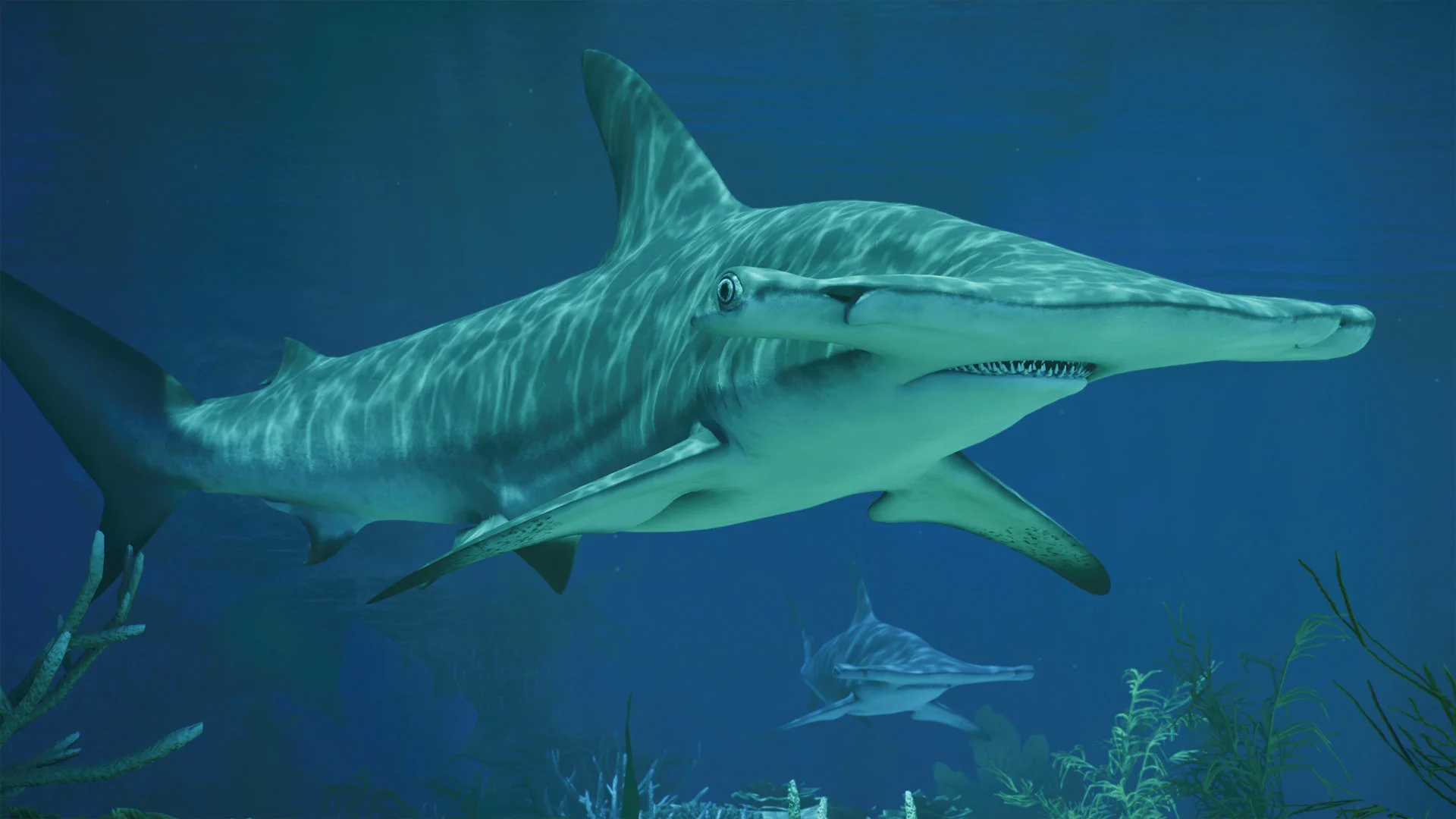
The great hammerhead (or Sphyrna mokarran) is a large species of shark that inhabits warm temperate and tropical waters worldwide. It most commonly dwells along continental shelves, lagoons and near coral reefs, though it may also be found in deeper offshore areas.
Great hammerhead sharks have a distinctive, nearly straight-edged hammer-shaped head with a notch in the centre. They have a tall, sickle-shaped first dorsal fin, and their colouration is grey-brown with a pale underside.
Females are larger and heavier than males, usually measuring over 4m and up to 6m, while males are usually smaller, averaging around 3m. Weight may average at 150kg for males and 230kg for females, though pregnant and very large females can reportedly weigh over 500kg.
Conservation Status
Critically Endangered, the great hammerhead is threatened across its range. Over the past 70 years, upwards of 80% of great hammerheads have been lost. Overfishing is a significant driver of population declines due to the demand for shark fins. The slow growth, late maturity and biennial reproductive cycles mean the great hammerhead has limited capacity to recover population losses. As its broad migratory behaviours span multiple national jurisdictions with inconsistent regulations and enforcement thereof, conservation management is very difficult.
Protection for great hammerheads takes place on national and international levels. Internationally, trade is regulated, while some countries have implemented catch limits and monitoring systems in addition to restrictions on the shark-fin trade. Local community projects often focus on minimising bycatch, and research is done to better understand population dynamics. Several marine protected areas provide at least some safe habitats across the shark’s range. While these combined efforts aim to stabilise populations, their effectiveness ultimately depends on consistent enforcement and international collaboration.
Social & Reproduction
As opposed to some other species of hammerhead, the great hammerhead shark is a solitary animal.
Great hammerhead sharks mate during warmer months, particularly spring and summer in the temperate areas of their range. During courtship and mating, pairs may circle around each other and ascend to the surface. Males may bite females to maintain position.
Gestation takes approximately 11 months, after which 6 to 50 live pups are born, 20 to 40 being a typical litter. Neonates are 50cm to 70cm long at birth, with initially rounded, flexible cephalofoils that gradually harden and straighten with growth. The pups are independent from birth, and females usually only breed every two years.
Sexual maturity is linked to achieving a certain body size, and as growth rates differ between the sexes, males typically become sexually mature between 5 to 9 years old, while females mature later and at a larger size, usually around 15 years old.
Habitat
Social
Biology
 3 cm
3 cm 6 cm 150 kg 230 kg