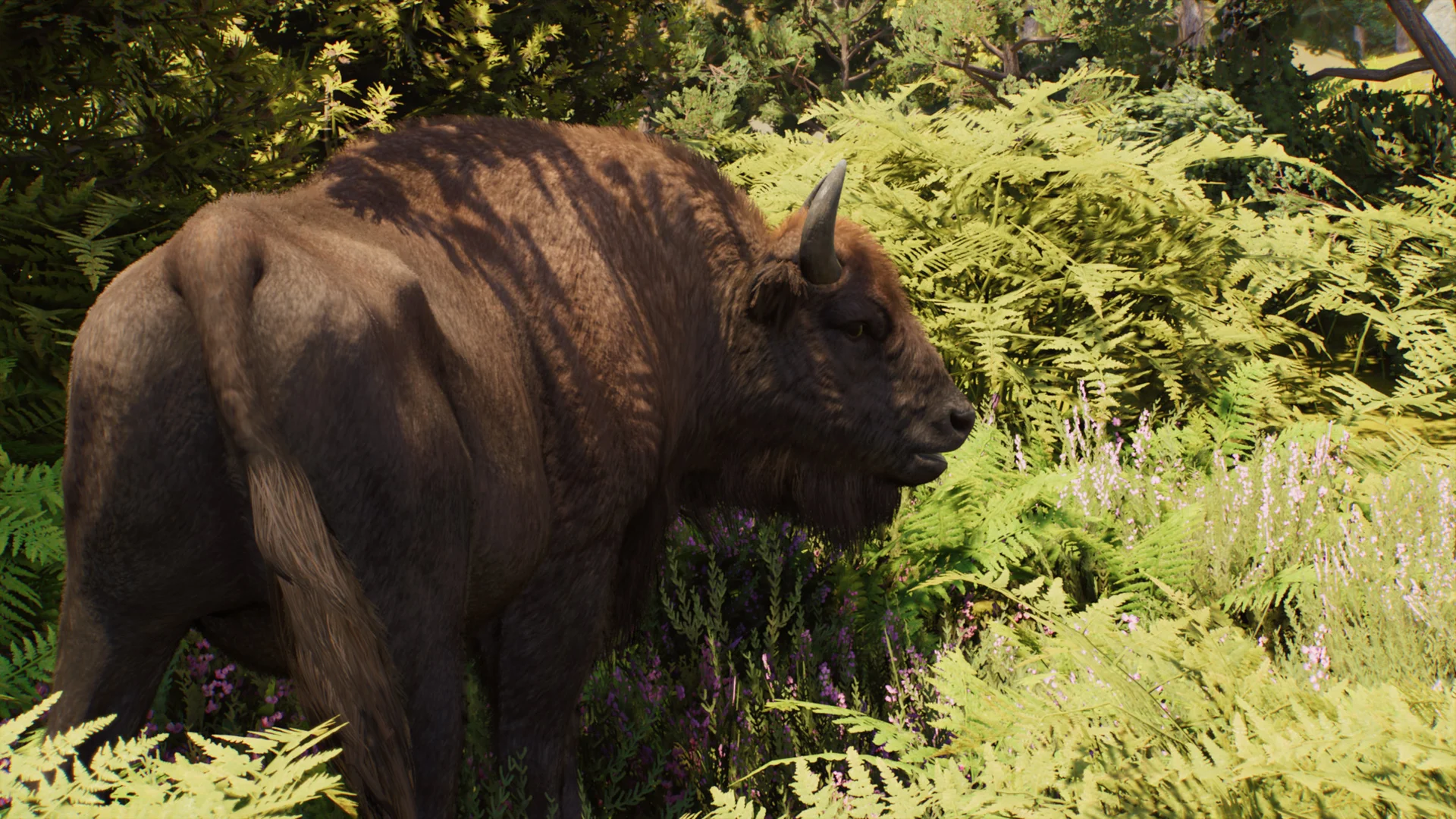
Bison bonasus
About
General
Wild Population: 2,518
The European bison (or Bison bonasus), also commonly referred to as the wisent, is a large ungulate living in the forests and meadows of Poland, Russia, Belarus, Lithuania, Ukraine, and Slovakia, in Eastern Europe.
European bison are characterised by their large head, shoulder hump and well-muscled forequarters, all of which are covered in a brown, shaggy coat. The hindquarters are less bulky and are covered in a thinner coat. Both males and females have curled horns that point inwards towards the head and look otherwise alike, though males are larger by about 5%.
Bulls grow 1.8m to 2.1m tall at the shoulder, 2.8m to 3.3m long, and weigh 615kg to 920kg. Cows are 1.7m to 2m tall at the shoulder, reach a length between 2.4m to 2.9m and a weight of 425kg to 635kg.
Conservation Status
Today, the European bison is considered a Near Threatened species. By the early 20th century, European bisons were driven to extinction in the wild due to overhunting and habitat loss. Only 60 individuals remained in captive or managed groups. Consequently, the species was offered widespread protection, and, through captive breeding and reintroduction programmes, the European bison was saved from disappearing completely.
Deforestation and habitat loss through agricultural development, as well as inbreeding depression and hybridisation with domestic cattle, still threaten the species today. Bovine tuberculosis transmitted by livestock also poses a risk. Carefully managed populations of European bisons have been successfully reintroduced in many areas of Europe, with further reintroductions planned. Reintroduction efforts have seen significant success, especially in Poland’s Białowieża Forest and Romania’s Southern Carpathians multiple free-ranging populations have been established.
Social & Reproduction
European bison live in mixed herds of females and their offspring, including sub adult males. Mature males live together in pairs or trios, except for breeding periods, where they fight each other for access to a group of females. Mixed herds often come together to exchange individuals, so they do not live in exclusive familial units.
In the mating season, taking place from August to October, dominant bulls, usually 6 years or older, attempt to join a group of females and defend them from rival males. Younger bulls will also join female groups, but are usually prevented from mating by the older male. If another mature bull approaches the herd, the two engage in a fight for their position. The bull assesses his female’s receptiveness to mating by sampling their urine. He will separate a female approaching oestrus from the group and guard her closely. When she is fertile, he will mount her to mate.
European bison cows are pregnant for 254 to 277 days, and give birth to a single calf. To deliver the calf, she leaves the herd for a few days, then returns with the infant. Weaning is complete when the calf is 14 months old.
Female European bisons reach sexual maturity at 3 years old, and remain with their mother’s herd. However, herds may exchange members when they meet, so herds aren’t exclusively family groups. Males become sexually mature at 2 years old and leave their natal group to join a bachelor herd, though they are unlikely to successfully mate until they are around 6 years old. At this point, they separate from their bachelor group and become solitary satellites hanging around the fringes of mixed groups until the next breeding season.
Habitat
Social
Biology
 2.1 m
2.1 m 2 cm 920 kg 635 kg