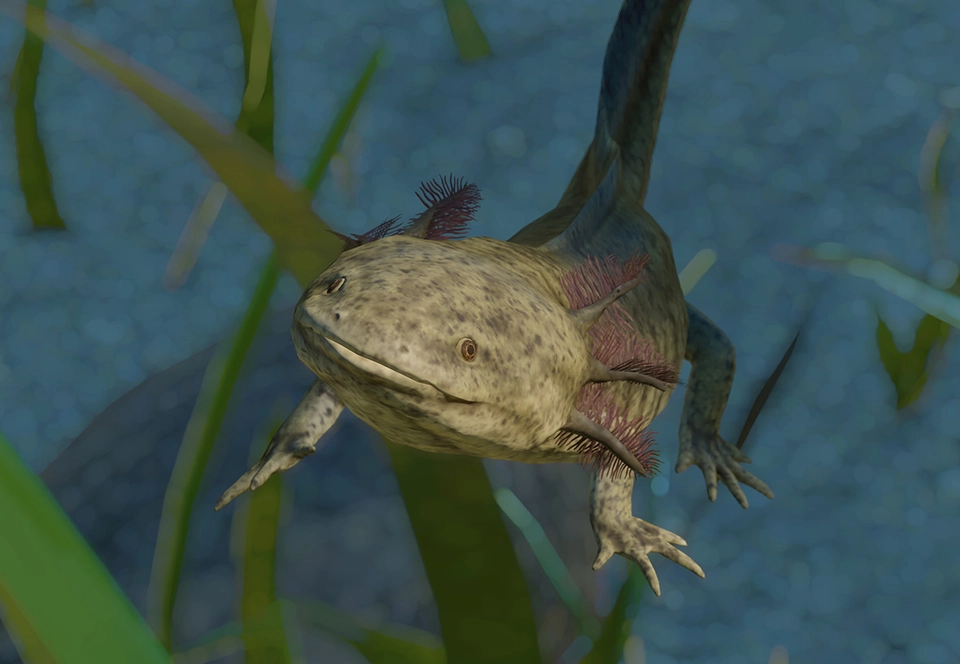
Ambystoma mexicanum
About
General
Wild Population: 50 - 1,000
The axolotl (or Ambystoma mexicanum) is an amphibian found exclusively in freshwater lakes in Mexico, with only Lake Xochimilco remaining as their natural habitat.
Its wild type is green and brown in colour, with dark speckles across the body, however axolotls in the pet trade are often leucistic (white) or come in a number of other, vibrant colourmorphs. They have prominent gill fans protruding from their necks, a feature common in all salamander larvae, although due to their more aquatic lifestyle, the axolotl keeps these external gills. Its face is wide, with small eyes and a large mouth.
They range between 15cm and 45cm in length, and average at around 300g of weight.
Conservation Status
Primarily due to habitat loss, the axolotl is Critically Endangered. Lake Chalco, one of their native bodies of water, was fully drained among other Mexican great lakes to prevent floods. Today, they only occur naturally in Lake Xochimilco near Mexico City, which has been fragmented into canal systems and has experienced high levels of pollution as a result of urbanisation and tourism. Invasive fish species in these waters further outcompete axolotls for what little resources remain. While the axolotl is very common in the pet trade, this population is believed to be fully captive bred, and collection for the wildlife trade is no longer a pressure on wild axolotls.
In recent years, through ongoing habitat restoration efforts and ecotourism initiatives, the water quality of Lake Xochimilco has improved. Until their habitat is free of invasive species and at a healthy level again, reintroductions of axolotls won’t be possible, despite the large and healthy captive stock in the pet trade and in research facilities.
Social & Reproduction
Axolotls are solitary in the wild and are happy living alone in captivity. However, unless different in size, they are content with other axolotls nearby, provided there is sufficient food and space.
If a male axolotl encounters a female in the mating season from March to June, he will initiate a courtship dance where they will both move in circles together. The male undulates his tail, while the female moves closer towards him. Eventually, he will deposit a spermatophore, a capsule containing his seed, which the female will take up into her cloaca.
She will individually lay hundreds of eggs between 2 hours and 2 days after mating, usually on plants and stones across a wide area. The larvae hatch after 10 to 14 days, and begin feeding within hours of hatching. From this point on, they are fully self-sufficient.
Axolotls, unlike other amphibians, do not undergo metamorphosis: they are paedomorphic, retaining characteristics of juveniles for life. While they are technically capable of metamorphosing, they do not produce the hormones to initiate this process. While other salamanders will lose their gills and begin living on land, axolotls remain in their aquatic larval form. Despite not transforming, axolotls reach sexual maturity between 1 and 1.5 years of age.
Habitat
Social
Biology
 45 cm
45 cm 45 cm 300 g 300 g