Information is taken from the game and may change or differ over time. Last updated .
Statistics
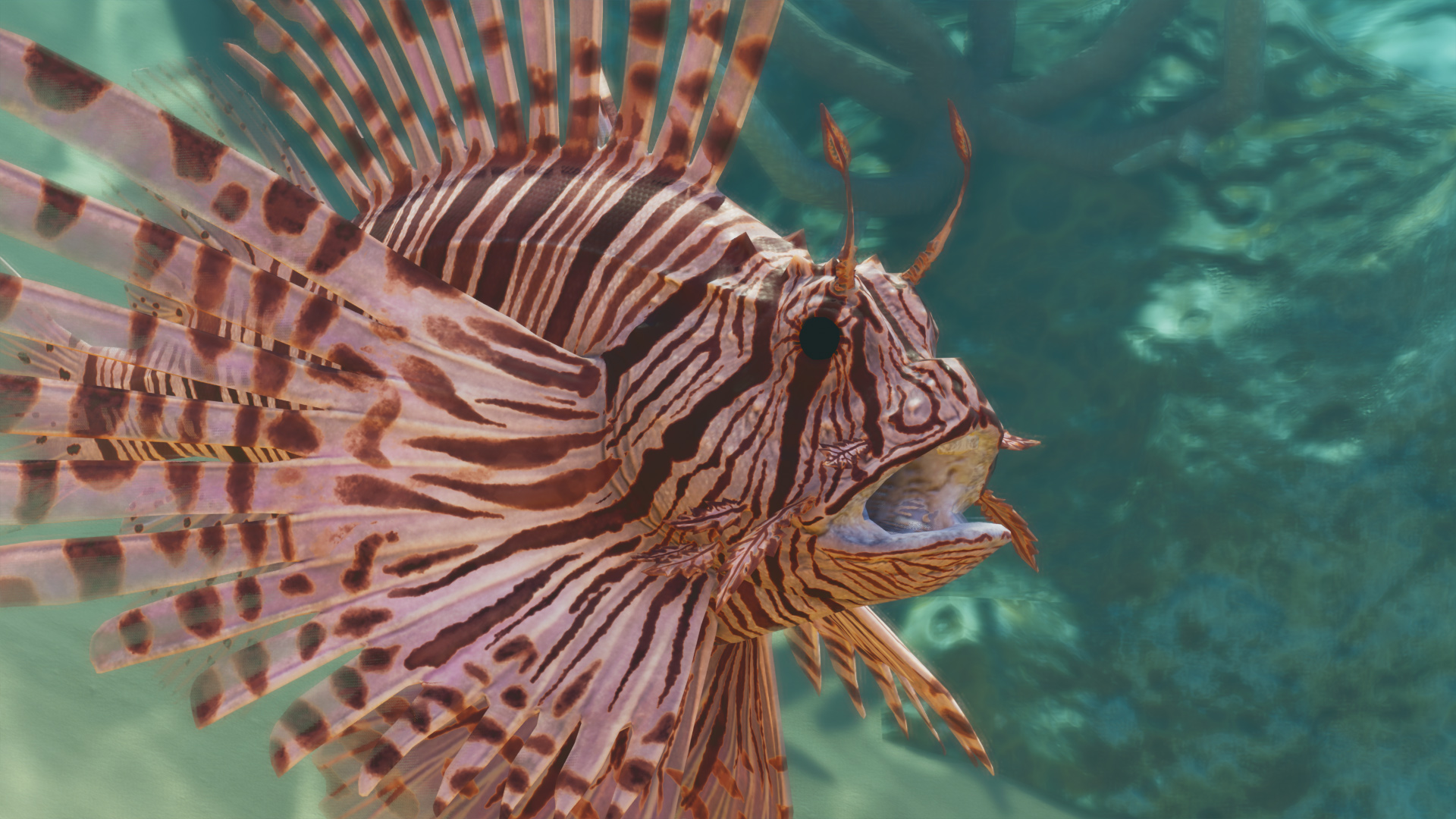
The red lionfish (or Pterois volitans) is a venomous reef fish native to the Indo-Pacific region, including the Red Sea, Indian Ocean, and western Pacific. Due to aquarium releases, it has become a well-established invasive species in the western Atlantic, Caribbean Sea, and parts of the Gulf of Mexico, where it threatens native marine ecosystems. Red lionfish typically inhabit coral reefs, rocky outcrops, lagoons, and seagrass beds.
The fish is easily recognised by its white and red body stripes, fan-like pectoral fins, and long venomous dorsal spines.
Adults measure 25cm to 32cm in length and weigh 1.2kg to 1.5kg, with males being slightly larger than females but otherwise no apparent difference between the sexes.
- The red lionfish possesses venomous spines along its dorsal, anal, and pelvic fins that can deliver a painful sting to predators and humans.
- The red lionfish can reproduce every 4 days, with females capable of releasing up to 2 million eggs per year in tropical conditions.
- The red lionfish is an ambush predator, using its large, fan-like pectoral fins to corner prey and then striking with rapid bursts of speed.
- The red lionfish can consume prey up to half its body length in size.
- The red lionfish has invaded over 7,000,000km² of ocean, including the Gulf of Mexico, Caribbean, and East Coast of the USA.
Habitat
Minimum habitat requirements
Planned population
Space
Barrier
Terrain
Environment
Preferred group ranges
Social
Red lionfish are solitary but will gather in temporary harems during breeding events.
 Suspended Bait
 Blood Scent Marker
 Bubble Blower - Airstone
Thriving relationships
0iNo compatible species


Release
Release requirements
Solitary Male
Release Groups can only be released via Conservation Projects or Quick Release.
Solitary Female
Conservation
The red lionfish is of Least Concern, and poses serious conservation challenges as an invasive species in the Western Central Atlantic. Introduced through the aquarium trade in the 1980s, lionfish have since spread rapidly due to their lack of natural predators and high reproductive rates. Their generalist diet has made them a top predator in many invaded habitats, and they significantly reduce populations of native reef fish by consuming large quantities of juvenile fish and crustaceans.
A variety of management and control efforts have been implemented to mitigate their impact. Organised lionfish culling programs, such as spear-fishing derbies and targeted removal dives, aim to suppress local populations and reduce pressure on native species. They are also being promoted as a human food source alongside safe handling techniques to encourage commercial harvesting. Research is being done to understand how native predators may accept lionfish as a food source as a long-term goal.
While eradication is currently impossible, the spread and ecological damage may at least be minimised.
Research
| Level | Unlocks | Bonus | Research gate |
|---|---|---|---|
| 1 | Thriving Requirement 1: at least 20 objects or plants with the Rocks tag; Red Lionfish Fact Sheet | ||
| 2 | Thriving Requirement 2: at least 5 objects or plants with the Coral tag; Fertility Level 1 | Fertility (+15%) | |
| 3 | Thriving Requirement 3: Food Grade 2; Release groups and release to the wild | ||
| 4 | Thriving Requirement 4: Coarse Sand terrain | ||
| 5 | Thriving Requirement 5: Smooth Rock terrain; Fertility Level 2 | Fertility (+30%) |
Conservation topics
Life
Reproduction
Lifecycle
Body
 34 cm
 34 cm
Breeding
Red lionfish mate year-round, though peaks in frequency in warmer months, which may be as often as every 4 days. A single, territory-holding male may gather a temporary harem of up to 7 receptive females. Courtship in such a harem involves circling, sidewinding, and leading displays. As broadcast spawners, the females release 4,000 to 30,000 eggs each, which float just below the surface, and the male releases his sperm so that the eggs are fertilised externally.
Once fertilised, the embryos develop rapidly, and larvae hatch approximately 36 hours after fertilisation. The lionfish larvae are free-swimming and pelagic, developing for 20 to 40 days while feeding on microscopic zooplankton. After this stage, they transition into their juvenile reef-dwelling form and settle in the benthic zone.
Red lionfish mature at around 1 year of age, coinciding with a body length of 17.5cm to 18cm in females and 10cm to 18cm in males.