Information is taken from the game and may change or differ over time. Last updated .
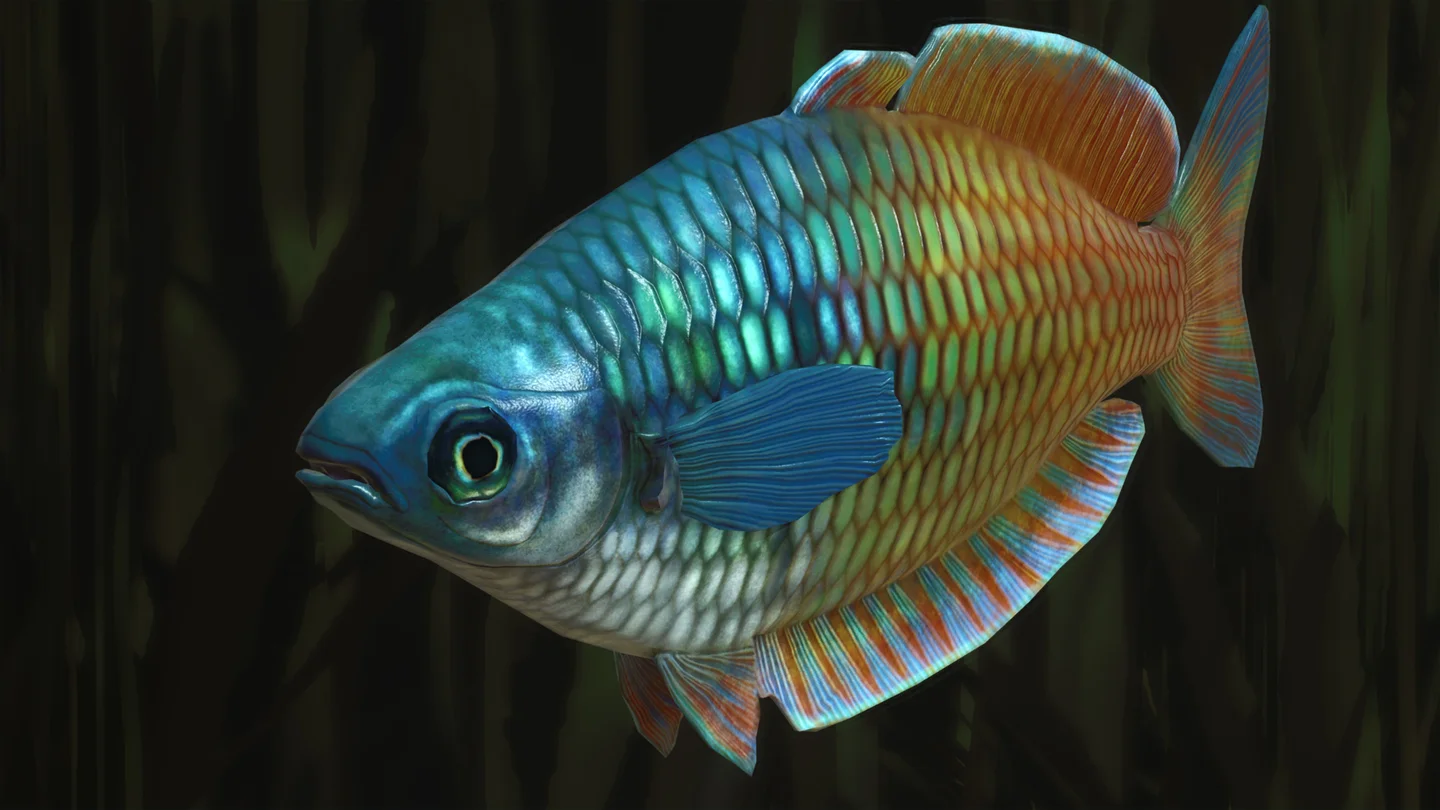
Melanotaenia boesemani
Boeseman's Rainbowfish
Unlocked at Accreditation Tier 3
Statistics
The Boeseman’s rainbowfish (or Melanotaenia boesemani) is a small, brightly coloured freshwater fish endemic to the Ayamaru Lakes and their tributaries in the Vogelkop (Bird’s Head) Peninsula of West Papua, Indonesia, where it inhabits shallow lakes and slow-moving waters with vegetation and clear water.
Adults typically reach around 8cm to 11cm, with males growing slightly larger than females and displaying the most vivid colours: a bluish-grey or purple anterior half and a vibrant orange-red posterior half. Females are generally slimmer and less intensely coloured.
- Boeseman’s rainbowfish is named after Dutch ichthyologist Marinus Boeseman, who described it in 1982.
- The Boeseman’s rainbowfish colours become brighter during courtship, dominance displays or when they are well cared for and stress-free.
- Because of their constant movement, shimmering colours and peaceful nature, Boeseman’s rainbowfish are often used as centrepiece fish in large community aquariums.
- Boeseman’s rainbowfish juveniles are mostly silver-grey and only develop their famous blue-and-orange colouration as they mature. It is stronger in males.
- In the wild, Boeseman’s rainbowfish eat algae, small crustaceans, insect larvae, and plankton; varied diet allows them to develop stronger colouration.
Habitat
Minimum habitat requirements
Planned population
Space
Barrier
Environment
Preferred group ranges
Social
Boeseman’s rainbowfish is a highly social schooling species that naturally lives in loose but cohesive groups. Social interaction is constant and includes parallel swimming, mild chasing, and visual displays, particularly among males.
Thriving relationships
0iNo compatible species
Neutral relationships
3i
Release
Release requirements
Mixed Shoal
Shoal health 40%. Can only be released via Conservation Projects or Quick Release.
Conservation
Boeseman’s rainbowfish is classified as Endangered, largely because it is endemic to a very restricted range on the Bird’s Head Peninsula in West Papua, Indonesia. Its entire wild population occurs in just a few freshwater bodies and is highly vulnerable to habitat degradation and disturbance. Habitat threats such as changes in water quality, sedimentation, fluctuating lake levels, and competition from introduced species further exacerbate declines. Historical and ongoing collection for the international aquarium trade has put substantial pressure on wild populations.
Captive breeding programmes and genetic monitoring efforts assess and maintain genetic diversity in captive strains to avoid inbreeding depression and retain fitness relative to wild populations. These insurance populations reduce pressure on wild stocks and allow reintroduction if natural habitats improve.
While further planning and enforcement remain urgently needed. Increased awareness and stricter collection controls are helping to address both direct exploitation and environmental degradation.
Research
| Level | Unlocks | Bonus | Research gate |
|---|---|---|---|
| 1 | Fertility Level 1 | Fertility (+15%) | |
| 2 | Boeseman's Rainbowfish Fact Sheet | ||
| 3 | Release groups and release to the wild | ||
| 4 | Fertility Level 2 | Fertility (+30%) |
Conservation topics
Life
Reproduction
Lifecycle
Body
 10 cm
 8 cm
Breeding
Breeding occurs year-round. Males actively court females by flashing bright colours, displaying intensified head and body hues, and performing ritualised swimming displays. When courting begins, males may swim rapidly in front of females and show off their intense fin and head colouration as a sign of fitness and readiness to breed.
Boeseman’s rainbowfish are egg-scattering spawners. Once a female permits, the pair will position themselves side by side or close together and release eggs and milt simultaneously, resulting in external fertilisation of the eggs as they drift toward spawning sites such as fine-leaved plants. After spawning, adhesive eggs stick to plants or other fine surfaces.
The eggs hatch in about 7 to 14 days depending on water temperature and conditions, and newly hatched fry are extremely small, initially relying on yolk reserves before becoming free-swimming. As juvenile fish develop, they begin forming schools and display the species’ characteristic vibrant two-tone colouration as they near sexual maturity at around 6 months old.