Information is taken from the game and may change or differ over time. Last updated .
Unlocked at Accreditation Tier 1
Statistics
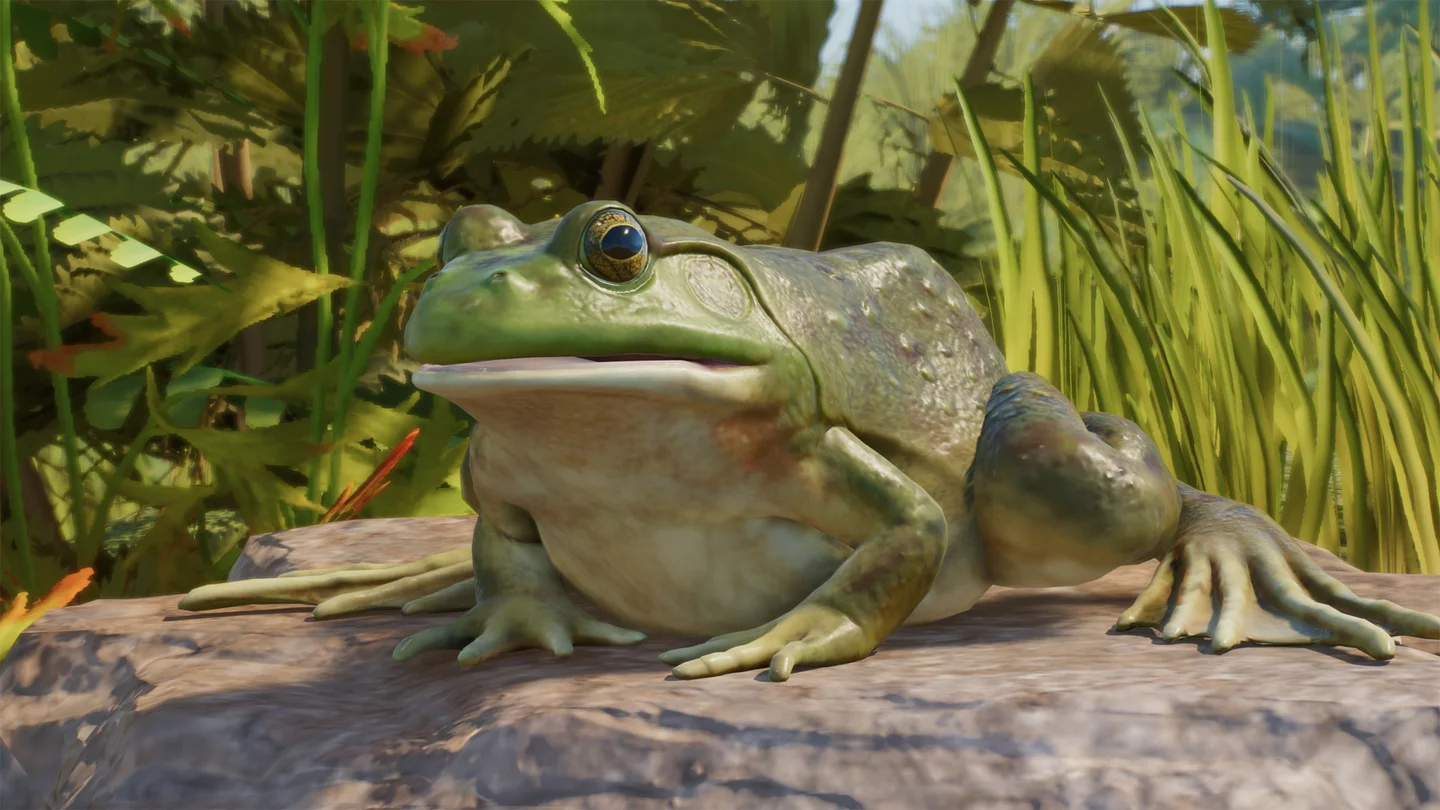
The American bullfrog (or Aquarana catesbeianus) is a large species of amphibian that lives in the swamps, ponds and lakes of the USA and Canada.
Depending on its environment, it may be dark green, pale green or pale brown dorsally with a paler coloured belly. It may have darker spots on its back and a banding pattern on its legs, although some variations of the bullfrog have no pattern.
The American bullfrog is sexually dimorphic: females are larger than males, and males have distinctive yellow colouration on their throat and a much larger tympanum (large, circular eardrum) on the sides of their head. The American bullfrog measures between 90mm to 152mm in length and weighs 300g to 500g.
- American bullfrogs lay approximately 20,000 eggs during each reproductive event.
- The American bullfrog is hunted for its legs in the Southern USA, which are a source of food.
- The American bullfrog is so named because the mating call of the male sounds like a bull’s bellow.
- The American Bullfrog can thrive in water temperatures between 15 to 30°C. However, tadpoles will begin to develop with abnormalities if water temperatures get higher than 32°C.
- The American bullfrog is a generalist predator that has been known to capture and eat bats, birds and tarantulas.
Habitat
Minimum habitat requirements
Environment
Preferred group ranges
Social
American bullfrogs will tolerate each other if there is enough space. They are known to gather in large groups during the breeding season, but males are often aggressive towards each other.
Release
Conservation
The American bullfrog is a species of Least Concern. It is an invasive species in South America, Western Europe, Southeast Asia, Japan and China. It is widely commercially farmed for both food and dissection in schools as a teaching tool.
Population control measures have been introduced in areas where the American bullfrog is a problem to prevent damage to the native wildlife because of the bullfrog’s opportunistic feeding habits, and as a vector for disease. Institutions continue to study actual and potential impacts of invasive populations on biodiversity and participate in eradication programs. Raising awareness and education of the issue is essential, especially given the bullfrog's tendency to escape captivity.
The bullfrog is highly abundant, and its global population is increasing. The eradication of the species from its introduced range is the main conservation concern.
Research
| Level | Unlocks | Bonus | Research gate |
|---|---|---|---|
| 1 | Fertility Level 1 | Fertility (+15%) | |
| 2 | American Bullfrog Fact Sheet | ||
| 3 | Release groups and release to the wild | ||
| 4 | Fertility Level 2 | Fertility (+30%) |
Conservation topics
Life
Reproduction
Lifecycle
Body
 12 cm
 12 cm 400 g 400 g
Breeding
Breeding season varies across its native range, between May and July in the north, and between February and April in the south. When population density is low, males establish and defend a territory of 3 to 6 square metres at a breeding site such as a swamp or pond and croak to attract females and fend off rival males. When population density is high, many males gather in the same area and vocalise. The extensive amount of croaking is called a ‘chorus’; it is believed that the louder and more numerous calls attract more females.
Males remain at the breeding site for the entirety of the breeding season to maximise their chances of mating multiple times. Females will visit the breeding site and only mate once, and usually all her eggs are fertilised by the same male. Females lay their eggs during copulation and fertilisation happens externally, forming a floating sheet 1m across. Eggs will hatch 3 to 5 days after being laid.
Tadpole growth is dependent on temperature and environmental conditions, and may take from 6 months up to 3 years to develop into froglets. Froglets may take another 2 years to become large enough to be considered a desirable mate, and are likely to mate for the first time between 3 and 5 years old, depending on how old they were at metamorphosis.